Supermarine S.6B
Supermarine · Air Racing / Speed Record · UK · Interwar (1919–1938)
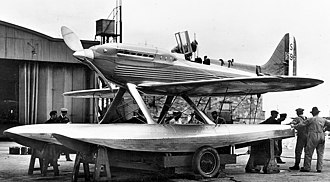
The Supermarine S.6B was the racing seaplane that won the 1931 Schneider Trophy outright for Britain — the third consecutive British win that retired the trophy permanently — and that set the absolute world airspeed record at 407.5 mph (655.8 km/h) on 29 September 1931. Designed by R.J. Mitchell at Supermarine, the S.6B's combination of streamlined seaplane configuration, supercharged Rolls-Royce R engine, and fuel-additive chemistry pioneered the design philosophy that, six years later, produced Mitchell's most famous aircraft: the Supermarine Spitfire.
The Schneider Trophy was an international seaplane racing series held between 1913 and 1931. By the late 1920s the contests had become national-prestige projects more than amateur sport: the British, Italian, and American teams each fielded purpose-built racers backed by their respective governments. Mitchell's Supermarine team had won in 1927 (S.5) and 1929 (S.6); a third consecutive win in 1931 would retire the trophy permanently. The British government initially withdrew funding for the 1931 attempt; private benefactor Lady Houston paid the full £100,000 cost to restore the team's participation.
The S.6B was an evolution of the 1929 S.6: a low-wing all-metal cantilever monoplane on twin floats, powered by a Rolls-Royce R engine — a special-purpose 12-cylinder supercharged V-12 producing 2,300 hp on a methanol/benzol/water fuel cocktail for short bursts. Two airframes were built (S1595 and S1596). The actual 1931 race was uncontested — the Italian and American teams withdrew — but Britain still had to complete the course at qualifying speed. Pilot Flight Lieutenant John Boothman flew S1596 around the seven-lap Solent course at an average 340.08 mph, securing the trophy. Two weeks later, on 29 September 1931, Flight Lieutenant George Stainforth flew S1595 to the absolute world record of 407.5 mph.
The S.6B's direct technical legacy was the Spitfire. Mitchell carried forward the streamlined low-wing configuration, the Rolls-Royce engine partnership, and the all-metal stressed-skin construction philosophy. The Spitfire prototype K5054 first flew on 5 March 1936 — less than five years after Stainforth's S.6B speed record. Both surviving S.6Bs are preserved: S1595 at the Science Museum London, S1596 at the Solent Sky Museum in Southampton.
For Kids — a shorter, friendlier version
The Supermarine S-6B was a racing seaplane built in Britain. It was designed by a man named R-J. Mitchell. It first flew in 1931 and became one of the fastest planes in the world.
The S-6B raced in a famous contest called the Schneider Trophy. This contest was a big international seaplane race. Britain had already won it in 1927 and 1929. Winning a third time in a row meant Britain got to keep the trophy forever. The S-6B did exactly that!
The British government almost did not send a team to race. A kind woman named Lady Houston paid the full cost herself. That was about one hundred thousand British pounds. Her gift saved the whole effort.
On September 29, 1931, the S-6B set a world speed record. It flew at over 407 miles per hour. That is faster than most propeller planes ever flew. It is faster than a speeding bullet train by many times.
R-J. Mitchell used lessons from the S-6B to design a famous fighter plane called the Spitfire. The Spitfire became one of the most loved planes ever built. So the S-6B helped change the future of flying.
Fun Facts
- The S.6B won the Schneider Trophy for Britain three times in a row — retiring it forever.
- It flew faster than 407 miles per hour, faster than any propeller plane had gone at that time.
- Lady Houston paid about one hundred thousand pounds so Britain could race — all by herself.
- The S.6B was smaller than a modern school bus, yet packed an enormous engine.
- Its powerful Rolls-Royce R engine used special fuel mixtures to squeeze out extra speed.
- R.J. Mitchell used ideas from the S.6B to later design the famous Spitfire fighter.
- The Schneider Trophy race ran from 1913 all the way to 1931.
- Britain, Italy, and America all built special racing seaplanes just to compete in the contest.
Kids’ Questions
What is the Schneider Trophy?
The Schneider Trophy was an international seaplane racing contest. It ran from 1913 to 1931. Teams from different countries built special fast planes just to win it. Britain won it three times in a row with planes designed by R.J. Mitchell.
Who paid for the S.6B to race?
The British government stopped paying for the race team at first. A generous woman named Lady Houston stepped in. She paid the full cost herself so Britain could still compete.
How did the S.6B help create the Spitfire?
Designer R.J. Mitchell learned a lot from building the S.6B. He used those ideas about speed and shape six years later. That work led him to design the famous Supermarine Spitfire fighter plane.
Variants
- S.6B S1595
- First airframe. Won the 1931 Schneider Trophy on 13 September 1931 (Boothman, 340.08 mph). Set the absolute world airspeed record at 407.5 mph on 29 September 1931 (Stainforth). Preserved at the Science Museum, London.
- S.6B S1596
- Second airframe. Set a closed-circuit speed record of 379.05 mph on 16 September 1931. Preserved at the Solent Sky Museum, Southampton.
Notable Operators
- Royal Air Force High Speed Flight
- Sole operator. The High Speed Flight was a small RAF-administered team based at Calshot, Hampshire, dedicated to Schneider Trophy racing. Flight Lieutenants Boothman, Stainforth, and Atcherley flew the S.6B.
- Supermarine (manufacturer)
- Designed and built both S.6B airframes at Woolston, Southampton, on Lady Houston's £100,000 sponsorship. R.J. Mitchell was chief designer; Sir Henry Royce led the Rolls-Royce R engine development.
Frequently Asked Questions
What was the Schneider Trophy?
An international seaplane-racing series held between 1913 and 1931, named after French sportsman Jacques Schneider. Three consecutive wins by the same nation retired the trophy permanently — Britain achieved this in 1927/1929/1931, ending the series. The Schneider Trophy is now permanently displayed at the Science Museum, London.
How fast did the Supermarine S.6B fly?
407.5 mph (655.8 km/h) — the absolute world airspeed record set by Flight Lieutenant George Stainforth on 29 September 1931 over the Solent. This was the first time any aircraft had exceeded 400 mph; the record stood until 1933.
Did the S.6B lead to the Spitfire?
Yes — directly. R.J. Mitchell carried forward the S.6B's streamlined low-wing configuration, all-metal stressed-skin construction, and Rolls-Royce engine partnership into the Type 224 (1934) and then the Type 300 / Spitfire (1936). The S.6B was the direct ancestor of every modern Spitfire and arguably the most important British aircraft of the 1930s.
What was the Rolls-Royce R engine?
A purpose-designed 12-cylinder supercharged V-12 racing engine producing 2,300 hp on a methanol/benzol/water fuel cocktail for short bursts. The R engine technology directly seeded the development of the Rolls-Royce Merlin engine — the powerplant of the Spitfire, Hurricane, Mosquito, Lancaster, and P-51 Mustang.
Where can I see a Supermarine S.6B today?
S1595 (the trophy-winner and speed-record holder) is preserved at the Science Museum, London. S1596 is at the Solent Sky Museum in Southampton, the city where the aircraft was built (Science Museum; Solent Sky).
Sources
See Also
- Supermarine Spitfire — Direct technological successor; same designer and engine partnership
- Macchi M.C.72 — Italian Schneider Trophy competitor; later world-speed-record holder
- Hawker Hurricane — Sister British Battle of Britain fighter
- Rolls-Royce Merlin — Production engine descended from the R-engine technology