Lockheed SR-71 Blackbird
Lockheed (Skunk Works) · Strategic Reconnaissance · USA · Early Jet (1946–1969)
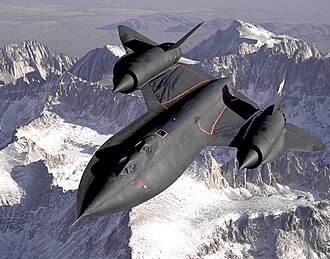
No aircraft has come as close to operating at the edge of the atmosphere as the Lockheed SR-71 Blackbird — and none since its 1998 retirement has come close to replacing it. Built by Lockheed's secretive Skunk Works division under chief engineer Kelly Johnson, the strategic reconnaissance aircraft entered United States Air Force service in January 1966 as the faster, heavier sibling of the CIA's A-12 spy plane. Its unmistakable silhouette — a needle fuselage flanked by two massive engine nacelles, the whole airframe finished in the heat-radiating flat black that gave the type its name — was shaped as much by thermodynamics as by aerodynamics. Flying routinely at Mach 3.2 above 85,000 feet, the Blackbird cruised at altitudes and velocities that rendered surface-to-air missiles essentially ineffective; the standard evasive maneuver was simply to accelerate away. Of the 32 aircraft built, not one was ever shot down.
The airframe demanded manufacturing methods Lockheed had to invent on the spot. Titanium made up 85 percent of the structure, yet working the alloy proved so difficult that 80 percent of early deliveries were rejected for metallurgical flaws. Fuselage panels were manufactured deliberately loose-fitting: they leaked JP-7 fuel on the ground before thermal expansion sealed the airframe at operating temperature. Cockpit windscreen exteriors reached 600°F during a mission. The aerodynamic chines running along the forward fuselage — adopted primarily to reduce radar cross-section — turned out to generate stabilising vortices that improved lift and lowered landing speeds, an unplanned bonus that engineers only discovered during flight testing.
Propulsion came from a pair of Pratt & Whitney J58 turbo-ramjet engines, each producing roughly 32,500 pounds of thrust in afterburner. Above Mach 3, the engines effectively transitioned into ramjet mode: the moveable inlet spike controlled the position of a shock wave inside the engine intake, and the inlet itself contributed 54 percent of the total thrust at cruise — more than the engine cores. Cesium-laced fuel reduced the radar return of the exhaust plume; black radar-absorbent material was applied to the wing leading edges and chines. The combination of altitude, speed, and reduced signature made interception effectively impossible: more than 1,000 missile launches were attempted against Blackbirds over their service life, and none scored a kill. The Soviet Union's nearest analogue, the MiG-25 Foxbat, was a high-altitude interceptor that could briefly match the SR-71's speed but lacked the range, endurance, and reconnaissance capability to displace it.
From bases at Kadena Air Base in Okinawa and RAF Mildenhall in England, the SR-71 flew strategic reconnaissance over North Vietnam, North Korea, Libya, Cuba, and along the Soviet Baltic and Barents coastlines, always overtly, always outside Warsaw Pact territory. In 1974 it crossed from London to New York in 1 hour, 54 minutes and 56 seconds — a transatlantic record that, as of 2026, still stands. In 1976 it set the absolute speed record for an air-breathing manned aircraft at 2,193 mph, another mark unbroken to this day. The aircraft's average mission rate was just one sortie per week; pre-flight preparation, including pressure-suit fitting and a full hour of fuel loading after thermal expansion sealed the tanks, dictated the cadence.
The USAF retired the fleet in 1989, citing budget pressure and the rise of reconnaissance satellites. A brief congressional reactivation in 1995 returned three aircraft to service before the type was retired again in 1998. NASA operated two airframes from 1991 to 1999 as high-altitude research platforms, supporting hypersonic propulsion and atmospheric studies. No replacement materialised: the proposed SR-72 hypersonic UAV remains a Lockheed Martin concept as of 2026, with no production decision. Strategic reconnaissance today is divided between satellites, the subsonic Lockheed U-2, and unmanned platforms. Surviving Blackbirds occupy museum collections at the Smithsonian's Udvar-Hazy Center, the National Museum of the United States Air Force, the Imperial War Museum at Duxford, and a dozen other institutions worldwide — testaments to a class of machine that has yet to be formally succeeded.
For Kids — a shorter, friendlier version
The SR-71 Blackbird is the fastest jet airplane ever flown. Pilots flew it faster than 2,000 miles per hour — three times the speed of sound, faster than a rifle bullet leaving the barrel. It flew so high (16 miles up!) that pilots had to wear spacesuits like astronauts, because there's not enough air to breathe at that height.
The Blackbird was painted black to help it cool down. Going so fast made the airplane heat up — the front windshield got so hot you could fry an egg on it. To handle the heat, engineers built the plane out of titanium, a super-strong silvery metal. Most of the titanium came secretly from the Soviet Union, even though the SR-71 was a spy plane that flew over Soviet territory!
The Blackbird's job was to take pictures from very high up — like a flying detective. From 1966 to 1998 it watched countries that were enemies of the United States during the Cold War. People tried to hit it with over 1,000 missiles. None of those missiles ever caught it — the pilots just sped up and outran them.
Today the SR-71 is retired and lives in museums. Nothing built since has gone as fast. If you visit the Smithsonian Air and Space Museum near Washington DC, you can stand right next to one.
Fun Facts
- The Blackbird leaked fuel on the ground on purpose — its panels were built loose, and only sealed shut when the plane got hot from flying fast.
- Cruising at top speed, the SR-71 covered a football field every fifth of a second.
- Its J58 engines burned a special fuel called JP-7 that wouldn't catch fire with a match — only a chemical igniter could light it.
- In 1974 a Blackbird flew from London to New York in 1 hour and 54 minutes. That record still stands today.
- Only 32 SR-71s were ever built, and not a single one was lost to an enemy attack.
- Pilots wore special pressure suits — NASA borrowed them for early astronaut training.
- The Soviet Union built a fighter jet called the MiG-25 to chase the Blackbird — but it could only match its speed for a few minutes before running out of fuel.
Kids’ Questions
How fast is Mach 3?
Mach 3 means three times the speed of sound — about 2,300 miles per hour. That's faster than a rifle bullet, and quick enough to fly from New York to Los Angeles in less than an hour and a half. Most passenger jets fly at about Mach 0.85, so the Blackbird went almost four times faster than the plane your family takes on vacation.
Why did the Blackbird need to fly so high?
At 85,000 feet the Blackbird was above almost everything else in the sky — higher than weather, higher than passenger jets, higher than most rockets could reach. From up there, its cameras could photograph a whole country in a single flight. The air is so thin at that height that the wings have to be designed differently from a normal plane, and pilots have to wear special pressure suits in case the cockpit ever loses air.
Is there a faster plane today?
No piloted airplane has ever flown faster than the SR-71 in normal service. Some rockets and experimental planes have gone faster, but they aren't airplanes you can fly day after day. Lockheed Martin is working on a new plane called the SR-72 that might one day go twice as fast as the Blackbird — but it's still being designed, and it won't have a pilot inside.
Variants
- A-12 Oxcart
- CIA single-seat predecessor, 13 built. First flew 1962, retired 1968. Slightly faster and higher than the SR-71 but with shorter range.
- YF-12A
- Three-aircraft interceptor prototype with AIM-47 missiles. Set speed and altitude records in 1965 before the program was cancelled in 1968.
- M-21
- Two-aircraft drone-carrier variant designed to launch the D-21 reconnaissance drone. One was lost in a fatal launch accident in 1966.
- SR-71A
- Primary operational variant, 29 built. The reconnaissance platform that flew all combat sorties over Vietnam, Korea, the Middle East, and Soviet borders.
- SR-71B
- Two-aircraft trainer with a raised second cockpit for an instructor. Both flew with USAF then NASA; one survives at the Kalamazoo Air Zoo.
- SR-71C
- Single hybrid trainer assembled from an SR-71B nose grafted onto a YF-12A airframe after the original SR-71B was lost in 1968.
Notable Operators
- United States Air Force (1966–1998)
- 9th Strategic Reconnaissance Wing at Beale AFB, California. Operational detachments at Kadena AB (Okinawa) and RAF Mildenhall (UK). Final retirement October 1998 after a brief 1995–98 reactivation.
- NASA (1991–1999)
- Two SR-71A airframes plus the SR-71B trainer flew from Dryden Flight Research Center as high-altitude research platforms supporting sonic-boom, hypersonic propulsion, and astronomy programs.
Frequently Asked Questions
How fast does the SR-71 Blackbird fly?
The SR-71 cruised at Mach 3.2 — roughly 2,193 mph or 33 miles per minute — at altitudes above 85,000 feet (USAF fact sheet). The official world speed record for an air-breathing manned aircraft, set by an SR-71 on 28 July 1976, stands at 2,193.2 mph and has not been broken in the half century since. The Soviet MiG-25 could briefly match the speed in interception, but only the SR-71 sustained it as a cruise condition.
Was the SR-71 Blackbird ever shot down?
No SR-71 was ever lost to enemy action in 32 years of operation, according to the USAF. Lockheed's Kelly Johnson stated that more than 1,000 surface-to-air missiles were fired at Blackbirds during their service life without a single hit. Twelve of the 32 aircraft built were lost to accidents, mostly during high-Mach flight testing.
Why is the SR-71 painted black?
The black paint contains iron ferrite, which serves a dual purpose: it absorbs and re-radiates aerodynamic heat (helping the airframe shed roughly 75°F of skin temperature compared to bare titanium), and it has mild radar-absorbing properties that reduce the aircraft's radar cross-section. The colour is functional, not aesthetic — and it gave the aircraft its enduring nickname.
How high can the SR-71 fly?
Service ceiling was officially 85,000 feet, though crews reported reaching 88,000 feet during operational missions. At that altitude, pilots wore full pressure suits identical to those used on the Space Shuttle; the curvature of the Earth was clearly visible, and the sky overhead appeared near-black even in daylight.
Why was the SR-71 retired?
The USAF retired the SR-71 in 1989 primarily for budgetary and political reasons rather than because the aircraft had been outclassed. Reconnaissance satellites had matured and were considered cheaper to operate, and the Blackbird's roughly $300 million annual operating cost (in 1990 dollars) was a target during post–Cold War defence cuts. Congress briefly reactivated three aircraft in 1995, but they were retired again in 1998.
Is there a successor to the SR-71?
No production successor exists. Lockheed Martin's proposed SR-72 — a hypersonic, optionally-unmanned reconnaissance/strike aircraft targeting Mach 6 — has been publicly discussed since 2013 but remains a concept as of 2026. Strategic reconnaissance is currently performed by satellites, the U-2, and various unmanned platforms.
How much did an SR-71 cost?
The unit production cost in the 1960s was roughly $34 million per aircraft (about $300 million in 2026 dollars). Operating costs were the larger expense: each flight hour cost an estimated $200,000 in late-1980s dollars due to the J58 engines, JP-7 fuel, pressure-suit support, and tanker-aircraft sortie requirements.
Where can I see an SR-71 today?
Surviving SR-71s are displayed at the Smithsonian's Udvar-Hazy Center (Virginia), the National Museum of the U.S. Air Force (Ohio), the Imperial War Museum Duxford (UK), the Museum of Flight (Seattle), the Strategic Air & Space Museum (Nebraska), the Evergreen Aviation Museum (Oregon), and roughly a dozen other institutions across the United States and the United Kingdom.
Sources
- Lockheed SR-71A — National Museum of the United States Air Force — USAF fact sheet covering specifications, mission history, and retirement
- Lockheed YF-12A fact sheet — NMUSAF — interceptor variant context
- NASA Dryden SR-71 high-altitude research — NASA fact sheet on the 1991–1999 research programme
- Lockheed SR-71 Blackbird — Wikipedia — Source text adapted under CC BY-SA 4.0
See Also
- Lockheed A-12 Oxcart — CIA single-seat predecessor
- Lockheed YF-12 — Interceptor variant
- Lockheed D-21 — Reconnaissance drone carried by the M-21 variant
- Lockheed U-2 — Subsonic strategic reconnaissance contemporary, still in service
- Mikoyan-Gurevich MiG-25 Foxbat — Soviet high-altitude interceptor counterpart
- Mikoyan MiG-31 Foxhound — Soviet successor to the MiG-25
- Northrop B-2 Spirit — Black-program American stealth platform
Further Reading
Books about the Lockheed SR-71 Blackbird
Want to dig deeper? Browse books, memoirs, and technical references on the Lockheed SR-71 Blackbird on Amazon.