Lockheed Senior Prom
UAV
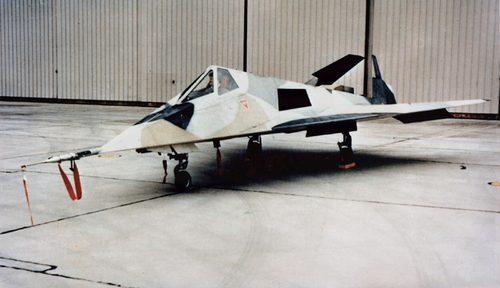
The Lockheed Senior Prom was a secret U.S. stealth cruise-missile technology demonstrator developed by Lockheed Skunk Works in the late 1970s under joint U.S. Air Force and DARPA sponsorship. As one of the earliest stealth cruise-missile demonstrators, it predated in-service programmes including the AGM-129 ACM (Advanced Cruise Missile) and a number of other secret stealth cruise-missile efforts. Between 4 and 7 prototypes were built, and flight testing ran from 1978 to 1980 at restricted ranges. Lessons from Senior Prom carried directly into the AGM-129 ACM (in U.S. Air Force service 1990–2007), the AGM-158 JASSM (in service from 2009), the AGM-158B JASSM-ER extended-range variant, and the AGM-158C LRASM (Long Range Anti-Ship Missile, in service from 2018).
The airframe was a faceted-stealth cruise missile roughly 14 ft (4.3 m) long with an empty weight near 1,500 lb. Power came from a small turbofan in the 600 lbf class, giving a cruise speed of Mach 0.7–0.8 and a range over 600 nmi. The faceted aerodynamic shaping — closely related to the approach later seen on the F-117 Nighthawk — drove the radar cross-section down, while autonomous flight controls and terrain-following navigation handled the subsonic penetration profile. Senior Prom remained secret through the 1990s, and declassification has been incremental, continuing into the 2020s.
For Kids — a shorter, friendlier version
The Lockheed Senior Prom was a secret American stealth cruise missile test program from the late 1970s. Skunk Works built between 4 and 7 prototypes. Senior Prom flight tests ran from 1978 to 1980 at secret bases. The project remained secret for decades.
The Senior Prom is 14 feet long, smaller than a school bus. A small turbofan engine made 600 pounds of thrust. Top speed was around 600 mph, faster than most race cars, just below the speed of sound. The missile could fly more than 600 miles to its target.
Senior Prom had a faceted shape, with flat surfaces angled to scatter radar waves. This made the missile hard for enemy radars to see. The same idea was later used on the famous F-117 Nighthawk stealth fighter. Senior Prom was an early step in American stealth technology.
Senior Prom led to many later American cruise missiles. The AGM-129 ACM stealth missile (in service 1990 to 2007) used Senior Prom ideas. So did the AGM-158 JASSM (in service from 2009), the JASSM-ER long-range version, and the AGM-158C LRASM anti-ship missile. Senior Prom's faceted-stealth heritage lives on.
Fun Facts
- Lockheed Senior Prom was a secret American stealth cruise missile from 1978 to 1980.
- The Senior Prom is 14 feet long, smaller than a school bus.
- Top speed was around 600 mph, faster than most race cars.
- Senior Prom could fly more than 600 miles to its target.
- Skunk Works built between 4 and 7 Senior Prom prototypes.
- The faceted shape made Senior Prom hard to see on radar.
- Senior Prom led to the AGM-129, AGM-158 JASSM, and LRASM cruise missiles.
Kids’ Questions
What is faceted stealth?
Faceted stealth means using flat panels angled to bounce radar waves away from the radar source. Senior Prom's body was made of many flat surfaces, like a cut diamond. Radar waves hit the panels and reflect in many directions, not back to the radar. This makes the missile hard to see. The F-117 Nighthawk used the same idea.
Why a stealth missile?
Normal cruise missiles can be hit by enemy radar-guided defenses. A stealth missile is hard to see on radar, so it can fly past defenses to reach its target. Senior Prom was the first American stealth cruise missile, paving the way for later ones. The AGM-129 ACM became the in-service stealth cruise missile from 1990.
Why was it secret?
America did not want enemies to know about stealth technology. If they did, they could build defenses to find stealth missiles. So Senior Prom flew in secret at remote test bases from 1978 to 1980. The program stayed secret for decades. Even today, some details about Senior Prom remain secret.
Variants
- Senior Prom prototypes (1978-1980)
- Between 4 and 7 prototypes built. Flight tests ran 1978–1980 at restricted ranges, demonstrating faceted-stealth aerodynamics, small-turbofan propulsion, and autonomous flight control. The programme concluded around 1980, with its results feeding directly into later stealth cruise-missile programmes.
Notable Operators
- U.S. Air Force / DARPA / Lockheed Skunk Works (developer)
- Sole programme sponsor. The U.S. Air Force and DARPA jointly sponsored development, with Lockheed Skunk Works as prime contractor. Flight testing ran 1978–1980 at restricted ranges, and the programme concluded around 1980 with its technology transferred into follow-on stealth cruise-missile work.
- Subsequent stealth cruise-missile programmes (heritage)
- Follow-on U.S. stealth cruise-missile programmes drew directly on Senior Prom: the AGM-129 ACM (in service 1990–2007), the AGM-158 JASSM family (in service from 2009), the AGM-158C LRASM (in service from 2018), and other secret and unclassified efforts.
Frequently Asked Questions
What was Senior Prom's significance?
It was an early stealth cruise-missile technology demonstrator that proved out faceted-stealth aerodynamics and autonomous-flight technologies for the subsonic stealth cruise-missile mission. Three points stand out: (1) proof-of-concept for a low-RCS cruise missile able to penetrate Soviet integrated air-defence systems; (2) a technology foundation for the in-service AGM-129 ACM and AGM-158 JASSM family; and (3) a Skunk Works engineering result that fed into later faceted-stealth aircraft work, the F-117 Nighthawk in particular.
How does Senior Prom compare to AGM-129 ACM?
Senior Prom was a technology demonstrator; the AGM-129 ACM was a fielded weapon. Senior Prom came from Lockheed Skunk Works, with 4–7 prototypes flown in a 1978–1980 test campaign focused on faceted-stealth technology demonstration. The AGM-129 ACM was built by General Dynamics (later Raytheon), produced in roughly 460 rounds, and served with the U.S. Air Force B-52 long-range bomber force from 1990 to 2007. ACM incorporated lessons from Senior Prom and other stealth cruise-missile work, providing the in-service baseline for later programmes.
Why was Senior Prom kept secret?
It was a Cold War stealth-technology programme. Secrecy protected the U.S. investment in low-observable shaping and the edge it offered against Soviet integrated air-defence systems. The 1970s–1980s U.S. stealth effort placed a high priority on security protection, and Senior Prom was no exception. Declassification has been incremental and continues into the 2020s, with engineering and historical documentation appearing in retrospective programme reviews.
What followed Senior Prom?
Several U.S. stealth cruise-missile programmes followed. (1) AGM-129 ACM (Advanced Cruise Missile) — fielded stealth cruise missile, in service 1990–2007 with the U.S. Air Force B-52 force. (2) AGM-158 JASSM family — fielded stealth cruise missile, in service from 2009 with U.S. and allied strike aircraft. (3) AGM-158C LRASM (Long Range Anti-Ship Missile) — fielded stealth anti-shipping missile, in service from 2018. (4) Other secret and unclassified U.S. stealth cruise-missile programmes through 2026.
Sources
See Also
- AGM-129 ACM — Subsequent in-service stealth cruise missile
- AGM-158 JASSM — Modern in-service stealth cruise missile
- F-117 Nighthawk — Skunk Works faceted-stealth aircraft heritage
- Have Blue — Skunk Works era-contemporary stealth demonstrator