HAL Tejas
HAL · Fighter / Attack · India · Digital Age (2010–present)
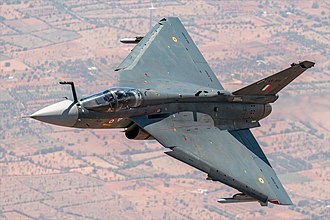
The HAL Tejas is India's first domestically designed and produced supersonic multi-role fighter, developed by Hindustan Aeronautics Limited and the Aeronautical Development Agency under the Light Combat Aircraft programme. Development began in 1983, but the project's complexity — India had never before built a supersonic aircraft — pushed first flight to January 2001 and induction into the Indian Air Force to July 2016, making the Tejas one of the longest development cycles of any fourth-generation fighter.
Powered by a single General Electric F404-IN20 turbofan producing 17,750 lbf with afterburner, the Tejas reaches Mach 1.8 at altitude and carries 9,260 lb of external payload across seven hardpoints. Its 26.9 ft delta wing — with no horizontal tail — gives the Mk 1 a maximum take-off weight of 27,558 lb. Combat radius on a hi-lo-hi interdiction profile exceeds 300 miles with two external fuel tanks; ferry range reaches 1,840 miles. The aircraft flies fly-by-wire with quadruplex digital flight control, necessary because the tailless delta configuration is inherently unstable.
Forty Tejas Mk 1 aircraft were produced through 2023 at a unit cost of $55 million, equipping Nos. 45 and 18 Squadrons of the Indian Air Force. The Indian government then contracted 83 Mk 1A aircraft featuring an active electronically scanned array (AESA) radar, electronic warfare suite, air-to-air refuelling probe, and Rafale-class beyond-visual-range missile compatibility. The Mk 1A order is valued at approximately $6.5 billion and represents a deliberate pivot away from imported platforms.
The follow-on Tejas Mk 2, with the GE F414 engine at 22,000 lbf, will push thrust-to-weight past 1:1 and add a longer fuselage for additional fuel and avionics volume. India's Navy has evaluated a carrier-capable Tejas variant for the INS Vikrant. The Tejas programme is the cornerstone of India's Atmanirbhar Bharat (self-reliant India) defence manufacturing drive, which also encompasses the HAL AMCA fifth-generation programme and indigenous aero-engines.
For Kids — a shorter, friendlier version
The HAL Tejas is a small, fast fighter jet built entirely in India. The name Tejas means brilliance or radiance in Sanskrit, an ancient Indian language. India's government wanted to build its own jet so the country would not have to buy all its fighter planes from other nations.
The Tejas has a delta-wing shape — a large triangle wing — that helps it turn sharply and fly fast. At top speed it can travel faster than a rifle bullet. It is a single-seat jet, meaning only one pilot flies it. A powerful American GE engine in the back pushes it to supersonic speeds.
The Tejas is smaller than many other fighter jets, which actually helps it dodge and twist during a fight in the sky. It carries radar in the nose to find other aircraft from far away. It can also carry missiles, bombs, and other weapons under its wings and body.
India's Air Force began flying the Tejas in 2016 after nearly 30 years of development. Building a modern fighter from scratch is one of the hardest engineering challenges any country can attempt. Over 80 improved Tejas Mk 1A jets are now on order for the Indian Air Force.
Fun Facts
- The name Tejas means brilliance in Sanskrit — India's ancient language.
- The Tejas has a triangle delta wing that helps it turn sharply in the sky.
- It is faster than a rifle bullet at top speed.
- India spent nearly 30 years developing the Tejas before it entered service in 2016.
- The Tejas is one of the lightest modern supersonic fighters in the world.
- Over 80 upgraded Tejas Mk 1A jets are on order for the Indian Air Force.
Kids’ Questions
Why does India want to build its own jet?
Buying fighter jets from another country means you depend on that country for spare parts, upgrades, and permission to use the jets in certain situations. Building your own jet means you control everything — the design, the upgrades, the cost, and who you sell it to. It also creates jobs for Indian engineers and scientists. The Tejas project turned India into one of the few countries that can design and build a supersonic fighter from the ground up.
What is a delta wing?
A delta wing is shaped like a large triangle — wide at the back and pointed at the front, like the Greek letter delta. This shape is very strong, has lots of room to carry fuel inside the wing, and works well at both slow and high speeds. Many supersonic fighters and even the Concorde passenger jet used delta wings. The Tejas uses a tailless delta wing, which means the big triangle does the job of both wings and a tail fin all in one shape.
Variants
- Tejas Mk 1
- Initial production variant with mechanically scanned EL/M-2032 radar and GE F404-IN20 engine at 17,750 lbf. 40 aircraft delivered to Nos. 45 and 18 Squadrons, IAF.
- Tejas Mk 1A
- 83-aircraft order featuring Israeli AESA radar, onboard electronic warfare suite, air-to-air refuelling capability, and beyond-visual-range missile integration. Deliveries from 2024.
- Tejas Mk 2 (MWF)
- Medium Weight Fighter with GE F414 engine at 22,000 lbf and a 1.6 m fuselage plug. Planned MTOW above 33,000 lb; projected to enter service in the 2030s.
- Tejas Navy NP-1/NP-2
- Carrier-capable variant evaluated for INS Vikrant and INS Vikramaditya. Reinforced undercarriage, folding wingtips, and arresting hook. Development ongoing.
Notable Operators
- Indian Air Force (No. 45 Sqn 'Flying Daggers')
- First operational squadron, inducted July 2016 at Sulur Air Force Station with 16 aircraft.
- Indian Air Force (No. 18 Sqn 'Flying Bullets')
- Second Tejas squadron, fully equipped by 2020 with Mk 1 aircraft at Sulur.
Frequently Asked Questions
When did the HAL Tejas enter service?
The Indian Air Force formally inducted the Tejas Mk 1 on 1 July 2016 at Sulur Air Force Station in Tamil Nadu, 33 years after the Light Combat Aircraft programme began in 1983. No. 45 Squadron 'Flying Daggers' was the first unit.
How fast is the HAL Tejas?
The Tejas Mk 1 reaches Mach 1.8 at high altitude, equivalent to roughly 1,190 mph, powered by the General Electric F404-IN20 turbofan at 17,750 lbf with afterburner. The tailless delta wing gives high agility at subsonic speeds as well.
How does the Tejas compare to the <a href="/v/dassault-rafale.html">Dassault Rafale</a>?
The Rafale is heavier, twin-engined, and more capable — its MTOW exceeds 54,000 lb versus 27,558 lb for the Tejas Mk 1. The Rafale carries more fuel, more weapons, and has a longer combat radius. The Tejas is less expensive at $55 million versus roughly $100 million for the Rafale, and its Mk 1A variant will close much of the avionics gap with AESA radar.
What weapons does the Tejas carry?
The Tejas Mk 1 carries the R-73 close-range air-to-air missile and Python 5 BVR missile on seven external hardpoints, plus a 23 mm GSh-23 cannon. The Mk 1A adds compatibility with the Derby NG and MICA beyond-visual-range missiles and can carry air-to-ground precision munitions including the Spice 2000 glide bomb.
What is the Tejas Mk 1A?
The Mk 1A is the 83-aircraft follow-on order signed in February 2021 for approximately $6.5 billion. It adds an active electronically scanned array (AESA) radar, a self-protection jammer, a digital electronic warfare suite, a retractable air-to-air refuelling probe, and beyond-visual-range missile wiring absent from the Mk 1.
Will India export the Tejas?
India has actively marketed the Tejas internationally. Argentina shortlisted it in 2021 before selecting the Rafale. Malaysia evaluated it against the JAS-39 Gripen. Egypt and several Southeast Asian air forces have received briefings. No export order had been confirmed by early 2026, but HAL sees export potential in the $3–5 billion range.
Sources
See Also
- Dassault Rafale — IAF twin-engine counterpart operating alongside Tejas
- Saab JAS 39 Gripen — Comparable lightweight single-engine fighter from Sweden
- F-16 Fighting Falcon — Benchmark lightweight multirole fighter the Tejas was sized against
- Eurofighter Typhoon — Heavyweight rival considered by the IAF before Rafale selection
- HAL HF-24 Marut — India's first indigenous jet fighter, predecessor programme
- Dassault Mirage 2000 — Tailless delta predecessor that informed Tejas aerodynamic design