Boeing Pelican ULTRA
Boeing Phantom Works · Ultra-heavy Strategic Cargo WIG · USA · Modern (1992–2009)
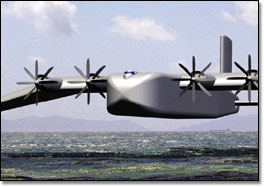
The Boeing Pelican ULTRA (Ultra Large Transport Aircraft) was a 2002-2003 Boeing Phantom Works concept study for a 1,400-tonne wing-in-ground-effect (WIG) freighter intended primarily for U.S. Army heavy-lift. No prototype was ever built. The Pelican exists only on paper, as engineering analysis and Phantom Works artist's-concept drawings, but it remains the largest WIG aircraft concept Boeing has formally publicised and the largest aircraft of any kind that Boeing has put in front of a public audience since the late-1960s SST programme.
The Pelican was specifically configured for ground-effect cruise. The aircraft would fly transoceanic legs at about 20 ft (6 m) above the sea surface, where the wing's downwash interacts with the surface to halve induced drag. Boeing's analysis showed a Pelican-class aircraft could achieve about 4× the lift-to-drag ratio of a comparable conventional transport. The trade-off was practical: WIG flight only works over flat sea, not over land or high seas, and the cruise altitude was too low to fly through any but mild weather. The concept was for transoceanic heavy-lift only, with conventional climb-and-cruise flight available for over-land segments.
The numbers were extraordinary. Wingspan: 152 m (500 ft) — bigger than a football field. Length: 122 m (400 ft). Maximum takeoff weight: 1,400 t (3,080,000 lb) — about 3.5× the An-225 Mriya. Payload capacity: 750 t (1,650,000 lb), or 17 M1 Abrams main battle tanks. Eight large turboprops in twin pods on each wing. Range: 18,500 km in WIG cruise, 13,000 km in conventional flight. Fuel-burn-per-tonne-mile was projected at about 25-30% of a conventional C-5 Galaxy or C-17 Globemaster III for transoceanic legs.
The Pelican never moved past Phantom Works concept-study phase. The U.S. Army declined to fund a prototype, the Air Force's heavy-lift requirement was already covered by the C-17 fleet, and the WIG aircraft category had no civil regulatory framework. As of 2026 several smaller WIG transport concepts have been proposed (Russian Kashtan, REGENT seaglider for passenger ferry) but no large WIG transport has flown. The Pelican remains a curio of early-2000s Boeing speculative engineering — extreme even by Phantom Works standards.
For Kids — a shorter, friendlier version
The Boeing Pelican ULTRA was a giant flying machine that Boeing dreamed up between 2002 and 2003. It was never actually built. Engineers just drew plans and did math to see if it could work. It stands as the biggest aircraft idea Boeing has ever shared with the public.
This huge plane was designed to carry very heavy cargo across oceans. It could lift about 750 tonnes of cargo at once. That is heavier than 500 large cars all loaded at the same time. Its wingspan was 500 feet wide, which is longer than a city block.
The Pelican had a very special trick for flying over the ocean. It would cruise just 20 feet above the water. Flying that close to the surface helps the wings work much better. This trick can cut drag in half and make the plane far more efficient.
The downside was that the Pelican could only use this trick over calm, flat ocean water. It could not fly that low over land or in rough weather. For land sections, it would fly higher like a normal plane.
Boeing made this concept for the American Army, which needed a way to move very heavy equipment across the world. Since no one ever built a prototype, the Pelican only lives on in drawings and engineering notes.
Fun Facts
- The Boeing Pelican ULTRA was never built — it only exists as drawings and engineering plans.
- Its wingspan was 500 feet wide, which is longer than one and a half American football fields.
- It could carry 750 tonnes of cargo, heavier than 500 large family cars combined.
- The whole aircraft would weigh about 1,400 tonnes fully loaded — that is heavier than 900 large pickup trucks.
- It would fly just 20 feet above the ocean surface, about as high as a two-story house.
- Flying close to the water cuts drag in half, making the plane much more fuel-efficient.
- Boeing's engineers found this design could be about four times more efficient than a normal cargo plane.
- The idea came from Boeing's secret research team called Phantom Works, which studies wild future aircraft ideas.
Kids’ Questions
Did the Boeing Pelican ever actually fly?
No, the Pelican never flew and was never even built. It only exists as engineering plans and concept drawings. Boeing studied the idea between 2002 and 2003 but never moved forward to build a real one.
Why did the Pelican fly so close to the water?
Flying very close to a flat surface like the ocean helps the wings work much better. It reduces a force called drag, which normally slows a plane down. This trick makes the plane use far less fuel on long ocean trips.
Could the Pelican fly over land too?
Yes, but not in the special low-flying mode. Over land, it would climb up and fly like a normal aircraft. The super-efficient low flying only works over calm, flat ocean water.
Who was the Pelican designed for?
Boeing designed the Pelican idea for the American Army. The Army needed a way to move very heavy equipment to faraway places across the ocean. The Pelican's huge cargo capacity made it a very interesting idea for that job.
Variants
- Pelican ULTRA (concept only)
- Single configuration studied. 500-ft wingspan, 750-t payload, eight turboprops. Cruise altitude 20 ft above sea surface in WIG mode. No prototype was ever built; programme remained at Phantom Works concept-study phase 2002-2003.
Notable Operators
- U.S. Army (proposed)
- The intended end-user. Boeing pitched the Pelican as a long-range heavy-lift platform that could move multiple armoured-vehicle battalions across an ocean in a single sortie. The Army declined to fund development.
Frequently Asked Questions
Was the Boeing Pelican ever built?
No — the Pelican never moved beyond Boeing Phantom Works concept-study and engineering-analysis phase between 2002 and 2003. No prototype, no scale model that flew, no flight hardware of any kind. It exists only as Phantom Works artist's-concept drawings and Boeing engineering reports.
What is wing-in-ground-effect flight?
Flight at about 1-2 wing chord-lengths above a flat surface (usually sea), where the wing's downwash interacts with the surface to halve induced drag. WIG aircraft are much more efficient than conventional aircraft at long-range cruise but only work over flat surfaces in mild weather. Soviet "Caspian Sea Monster" Ekranoplans were the most famous historical example.
How big was the Pelican?
Wingspan 152 m (500 ft) — about 50% wider than the An-225 Mriya. Length 122 m (400 ft). Maximum takeoff weight 1,400 t (3,080,000 lb) — 3.5× the An-225. The Pelican was the largest aircraft Boeing has formally proposed in the post-SST era.
Why did the Pelican fail to get funded?
Several reasons: U.S. Army heavy-lift demand was already covered by the C-17 Globemaster III; the Air Force was sceptical of the WIG concept's weather restrictions; no civil regulatory framework existed for WIG aircraft of any size; and the development cost (estimated multi-tens-of-billions) was uncompetitive against incremental upgrades to existing C-5 Galaxy and C-17 fleets.
Are there any large WIG aircraft flying today?
No large WIG aircraft has ever entered commercial or military service. The Soviet Lun-class and KM Caspian Sea Monster Ekranoplans of the 1960s-1980s were the closest historical comparisons, but neither saw operational deployment. Smaller WIG concepts (REGENT seaglider for passenger ferry) are in development but at much smaller scale.
Sources
See Also
- Antonov An-225 Mriya — Largest aircraft actually built and flown (one third the Pelican's projected MTOW)
- Antonov An-124 Ruslan — Production heavy-lift counterpart
- Lockheed C-5 Galaxy — U.S. heavy-lift incumbent
- Hughes H-4 Hercules — 1947 outsize-cargo flying boat (Spruce Goose)
- Boeing X-48 BWB — Sister Boeing Phantom Works experimental airframe